


Kuniyoshi - The Twenty-four Chinese Paragons of Filial Piety
Kuniyoshi - The Twenty-four Chinese Paragons of Filial Piety
Kuniyoshi Utagawa
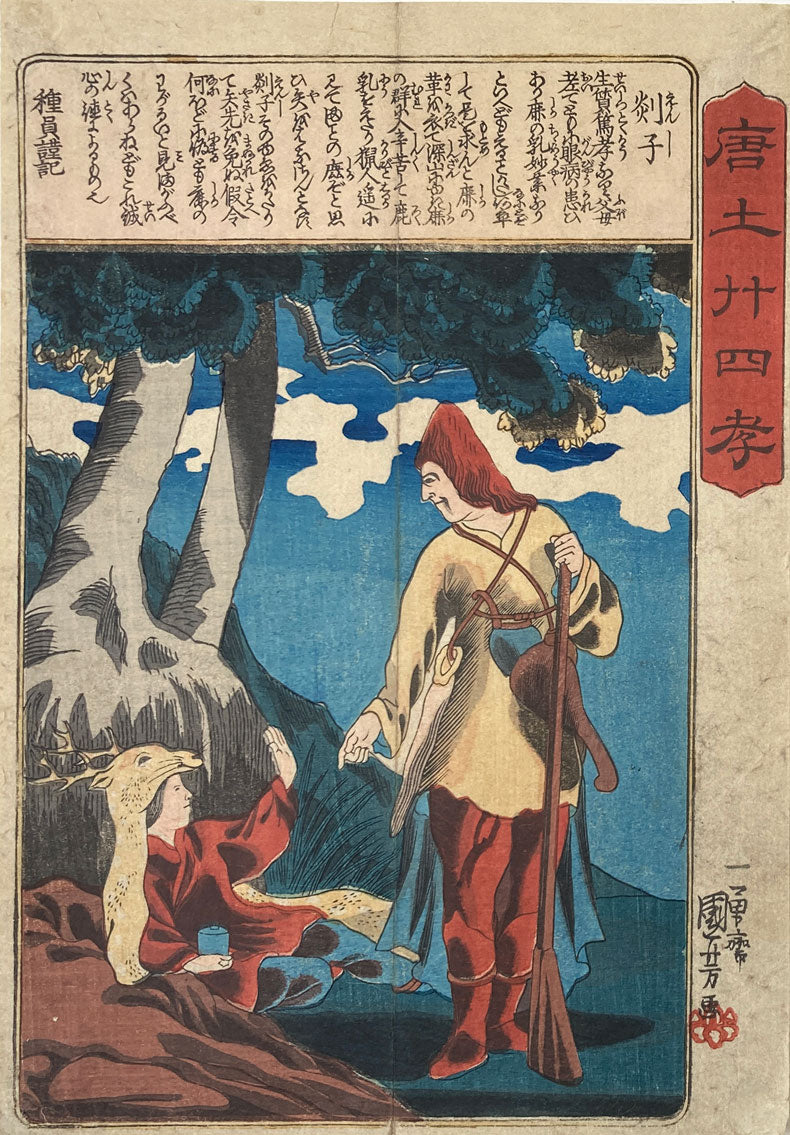
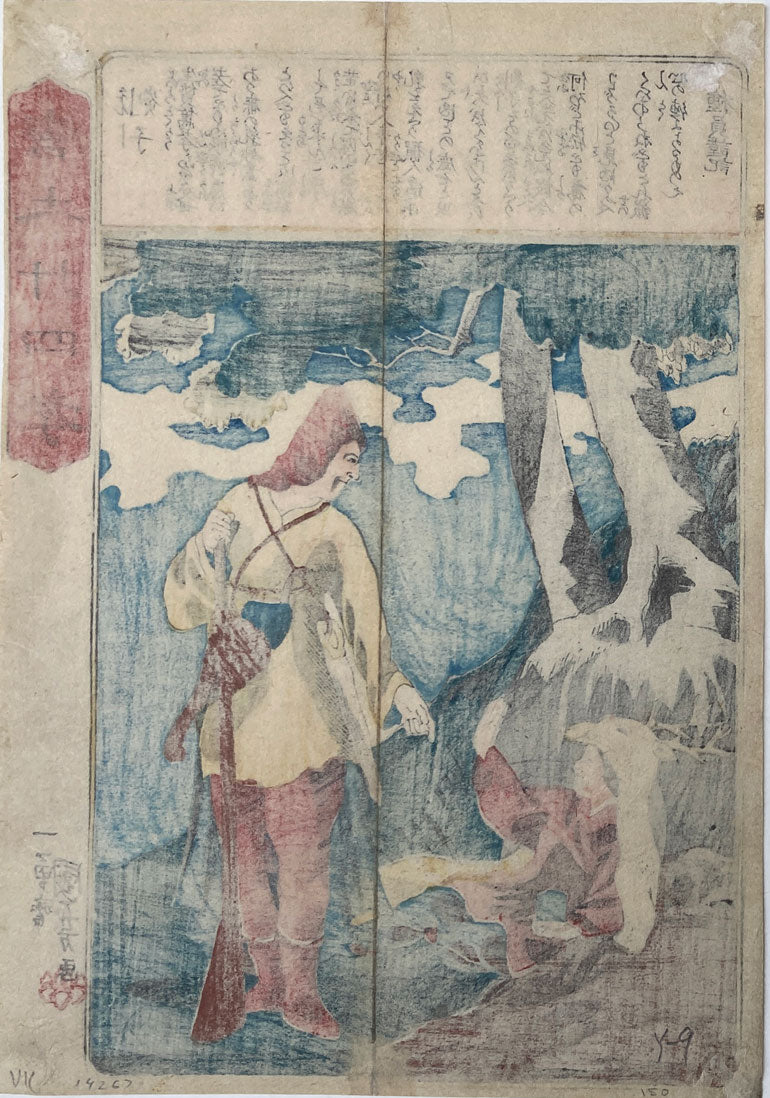
Tanzi (Enshi), from the series "The Twenty-four Chinese Paragons of Filial Piety". This is print number 20 in the series.
Because his old parents yearn for deer’s milk,
he swathes himself in a brown furry robe.
Had he not spoken up loudly, he would have
gone home wearing an arrow from the mountains.
Zen Shi was so filial that he sought to throw away his life for his parents’ sake. The reason is this: Zen Shi’s mother and father were old, and because they both suffered from maladies of the eyes, they longed to have the milk of a deer as medicine. Because Zen Shi had always been a filial child, he wished to achieve his parents’ desire. He therefore donned a deerskin and slipped inside a large herd of deer. Seeing this, some hunters took Zen Shi to be a real deer, and they prepared to shoot him with their bows. At that moment Zen Shi shouted, “I am not a real deer! My name is Zen Shi, and I have disguised myself as a deer so that I might fulfill my parents’ desire.” The hunters were surprised, and when they asked him how this could be, Zen Shi explained everything. Thus, it was thanks to the profundity of his filial devotion that Zen Shi was able to return home without being shot. Indeed, as a person, how could anyone acquire the milk of a deer just because someone wants it? Nevertheless, it is moving to imagine the thoughtfulness of Zen Shi’s filial piety.
The book entitled The Twenty-four Paragons of Filial Piety was written by the Chinese scholar Guo Jujing during the Yuan Dynasty. His pen name was Yizi, and he is known in Japan as Kaku Kyokei. The book recounts the self-sacrificing behavior of twenty-four sons and daughters who go to extreme lengths to honor their parents, stepparents, grandparents, and in-laws. Many of the images in this series appear Western in style, rather than Japanese, and were probably copied from Italian prints.
Date: 1848
Size: 10 1/4 x 7 1/4 in. (26 x 18.4 cm)
Condition: Good color and impression, not backed, fold down center and minor glue residue on back as shown.
Genre: Ukiyo-e
Medium: Original Woodblock Print
https://woodblockprints.org/index.php/Detail/objects/278
https://collections.mfa.org/objects/217861
Couldn't load pickup availability
 Worldwide Shipping
- 30-Day Returns
 Authentic Print Guarantee


Who Was Utagawa Kuniyoshi
Utagawa Kuniyoshi (1797–1861) was one of the most inventive and dynamic designers of ukiyo-e prints in late Edo-period Japan. Born in Edo (modern Tokyo), the son of a silk dyer, he developed an early sensitivity to color and pattern that would later define his work. At age 14, he entered the studio of Utagawa Toyokuni, though he struck out independently in 1814 and initially struggled to establish himself.
Kuniyoshi’s breakthrough came in 1827 with his celebrated series The 108 Heroes of the Suikoden, inspired by a Chinese novel about outlaw heroes. These bold, energetic warrior prints—filled with dramatic compositions, tattoos, and movement - secured his reputation as a master of musha-e (warrior imagery). Yet his range extended far beyond battle scenes: he produced refined landscapes influenced by Western perspective, imaginative triptychs such as the famous giant skeleton of Princess Takiyasha, and numerous depictions of historical and literary subjects.
Known for his wit and ingenuity, Kuniyoshi often circumvented censorship through visual wordplay and satire. He also collaborated with major artists like Utagawa Hiroshige and Utagawa Kunisada on popular series. A devoted cat lover, he frequently included cats in his prints and daily life. Despite declining health late in life, Kuniyoshi remained highly influential, training over 70 students, including Tsukioka Yoshitoshi.

Guaranteed Authentic
All our original woodblock prints are guaranteed authentic as described and shown. Unlike some print resellers, we don't make any Photoshop enhancements or add filters to our print images. Please check the print images front and back carefully before purchase, if you'd like additional pictures feel free to contact us. If, after purchase, you're not satisfied for any reason, return your print for a full refund within 30 days.
Collector Reviews
-

It's a great looking piece which I am very happy and excited to add to my small collection! I really appreciate it.
I enjoy your YouTube videos and I look forward to picking up more prints from you in the future.
Rick
-
Dear Mr. Richard, opening the package and seeing the incredible bright colours and ornamental abundance of Yoshitoshi's diptych, it was just as printed today! It will be a pleasure to get more of your fine selected prints.
L. F.
-
Josh and I just opened the package and want to thank you for this amazing Hiroshige print. The condition is better than we expected. Lovely to look at, will bring the family great joy. Happy New Year and thank you again.
J.

Kuniyoshi Videos
-

Who Was Kuniyoshi?
View on YouTubeKuniyoshi was a phenomenal artist. An expert at warrior prints. Known for his popularization of tattoos.
-

Unboxing Kuniyoshi's Whale
View on YouTubeJoin me as I unbox one of Kuniyoshi's most famous triptychs - Musashi vs the Whale. We learn the background of this print.
-

Good Cats Bad Cats in Ukiyo-e
View on YouTubeWe explore cats in Japanese prints. Of course Kuniyoshi was the number one cat lover and included them in many prints.


