


Yoshimori - The Battle of Ueno
Yoshimori - The Battle of Ueno
Utagawa Yoshimori (1830–1884)
Date: 1869
Publisher: Gusokuya Kahei
Genre: Ukiyo-e, Musha-e
Medium: Woodblock Print. Triptych: 35cm x 23cm/sheet
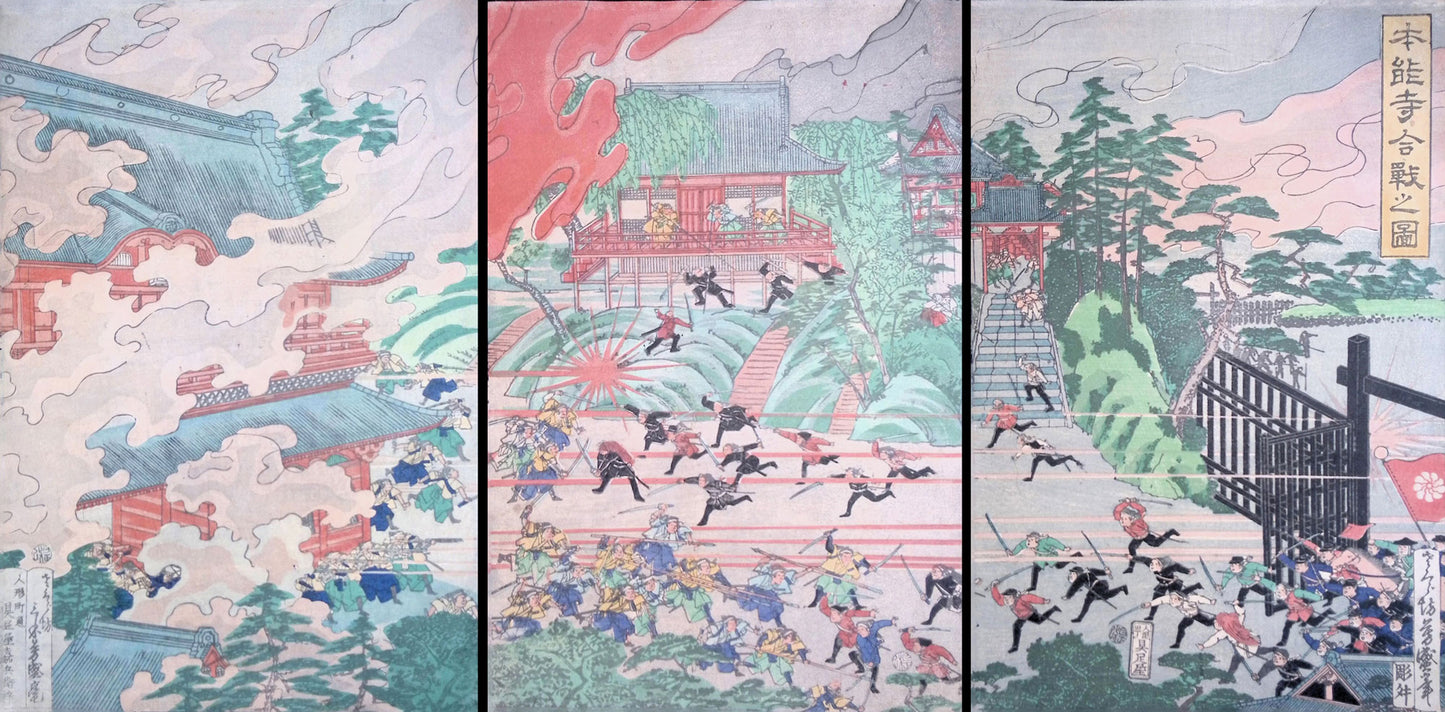
The title of this print is the "The Battle at Honnô-ji Temple (Honnô-ji kassen no zu)" but it appears to depict the Battle of Ueno at Kaneiji Shrine in 1868.
The battle depicted here occurred during the Boshin War (1868–1869), the civil conflict between forces loyal to the new Meiji government and those aligned with the Tokugawa shogunate. The fighting takes place at Kaneiji, the great Tendai temple complex that had long stood as a spiritual stronghold of the Tokugawa regime.
This highly detailed composition shows Meiji imperial troops, dressed in modern black uniforms, advancing through the temple grounds and buildings as they clash with samurai defenders. Armed with swords, spears, and naginata, the shogunate warriors fight with determination but are ultimately outmatched by the rifles and artillery of the imperial forces. Several figures wear the distinctive shaguma, or “red bear” wig, identifying them as soldiers of the Tosa domain fighting in support of the Emperor. Smoke and flames roll across the sky as gunfire streaks through the air, creating a dynamic and dramatic visualization of this decisive moment in Japan’s transition from feudal rule to modern statehood.
Condition: Good color. Cropped as shown. Backed on thin paper. Sheets are joined.
https://collections.mfa.org/objects/533704
Couldn't load pickup availability
 Worldwide Shipping
- 30-Day Returns
 Authentic Print Guarantee



The Satsuma Rebellion
The Satsuma Rebellion (1877) was the last major civil war of the samurai era and one of the defining conflicts of early modern Japan. It unfolded during the rapid modernization of the Meiji period and was documented at the time by prominent woodblock artists such as Yoshitoshi, Adachi Ginkō, Toshihide, and others, who produced dramatic triptychs and battle scenes for a public eager for news of the fighting.
The roots of the rebellion trace back to the fall of the Tokugawa shogunate in 1868. After more than two centuries of relative isolation, Japan opened to the West and embarked on sweeping political and military reforms under the restored imperial government. Feudal domains were abolished, a national conscript army replaced the hereditary warrior class, and the samurai lost their stipends and social privileges. These changes dismantled the traditional order that had defined Japanese society for centuries.
Many former samurai felt betrayed by the pace and direction of reform. Their most prominent leader was Saigō Takamori of Satsuma (modern Kagoshima), a key figure in the Meiji Restoration who later broke with the government. In early 1877, tensions escalated into open revolt. Saigō and roughly fifteen thousand followers marched north, clashing with Imperial forces at Kumamoto Castle and in a series of hard-fought battles across Kyūshū. Despite their reputation and determination, the rebels were outmatched by modern rifles, artillery, and vastly superior numbers.
The rebellion ended at the Battle of Shiroyama, where the remaining samurai made a final stand and Saigō was killed. The defeat confirmed the dominance of the modern state and effectively marked the end of the samurai as a military class. Prints from this conflict capture a pivotal historical moment - the dramatic transition from feudal Japan to a centralized, modern nation - and remain among the most compelling subjects in Meiji-era war imagery.

Guaranteed Authentic
All our original woodblock prints are guaranteed authentic as described and shown. Unlike some print resellers, we don't make any Photoshop enhancements or add filters to our print images. Please check the print images front and back carefully before purchase, if you'd like additional pictures feel free to contact us. If, after purchase, you're not satisfied for any reason, return your print for a full refund within 30 days.
Collector Reviews
-

It's a great looking piece which I am very happy and excited to add to my small collection! I really appreciate it.
I enjoy your YouTube videos and I look forward to picking up more prints from you in the future.
Rick
-
Dear Mr. Richard, opening the package and seeing the incredible bright colours and ornamental abundance of Yoshitoshi's diptych, it was just as printed today! It will be a pleasure to get more of your fine selected prints.
L. F.
-
Josh and I just opened the package and want to thank you for this amazing Hiroshige print. The condition is better than we expected. Lovely to look at, will bring the family great joy. Happy New Year and thank you again.
J.
