
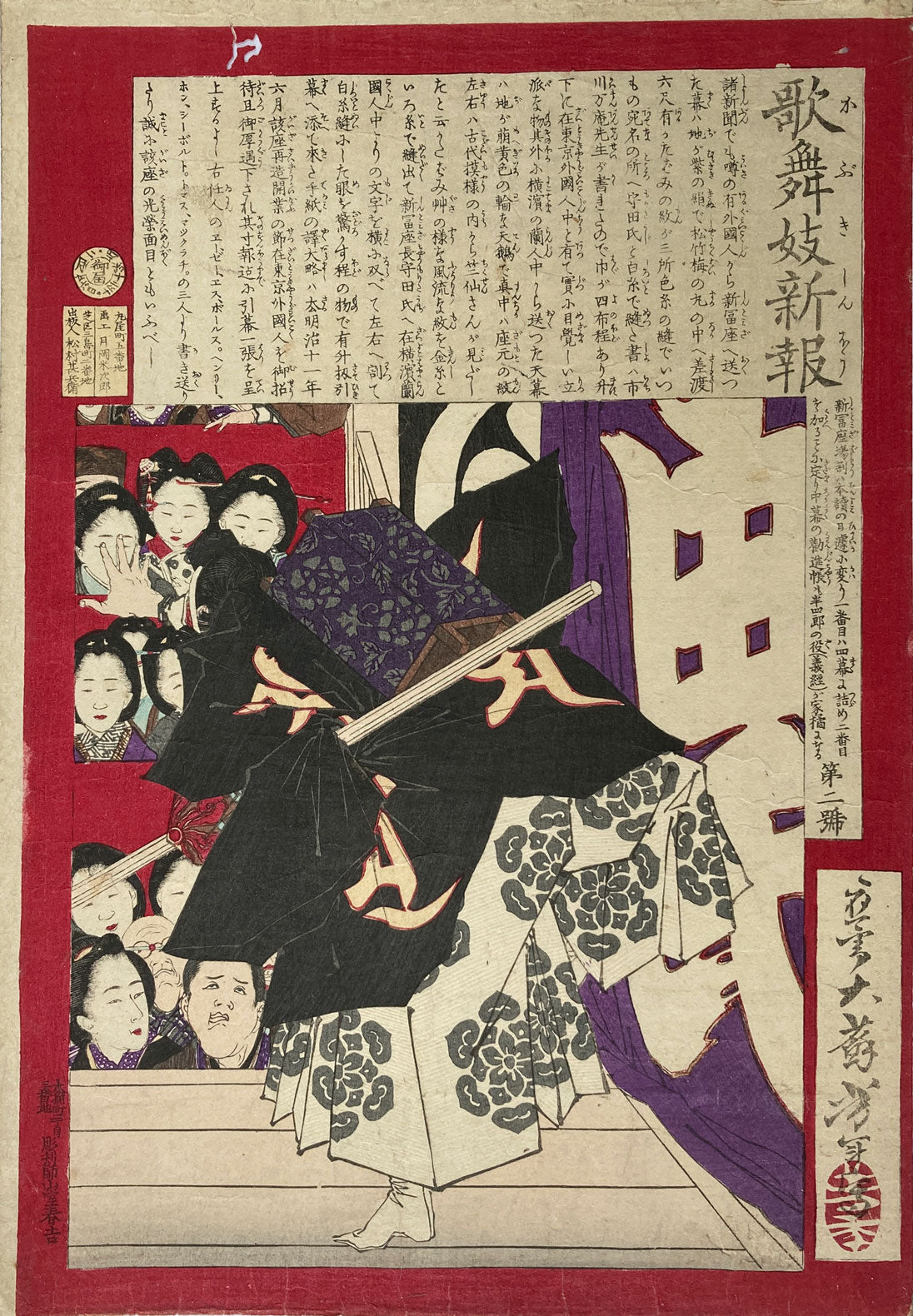
Yoshitoshi - Actor as Musashibō Benkei in Kanjinchō
Yoshitoshi - Actor as Musashibō Benkei in Kanjinchō
Tsukioka Yoshitoshi
This is from issue #2 of the Kabuki Shimpo. In this image we are behind the actor on the stage. We can read in the translation below, an explanation of the curtain and a welcome to foreigners. This is a really interesting perspective on a performance, and quite comical to see the audience watching from their seats.
(Translation from http://www.lib.iii.u-tokyo.ac.jp/collection/ono_sn/10.html)
The "Kabuki Shimpo" 歌舞伎 新報 began publishing in 1879 and ended in 1897. The cost was 3 sen. It contained news, gossip, and information about various plays and actors. The issues included pictures by artists and woodblock printed inserts. Some consider the Kabuki Shimpo as " the ancestor of modern theater magazines"
Shigetoshi Kawatake stated, "In short, this magazine itself can be said to be a three-dimensional history of the Meiji theater" the other contents as a whole are also "basic materials indispensable for Meiji theater research”.
Date: 1879
Genre: Ukiyo-e
Medium: Woodblock Print
Condition: Good color and impression. Backed with Meiji-era paper. Minor insect damage on top red border.
Couldn't load pickup availability
 Worldwide Shipping
- 30-Day Returns
 Authentic Print Guarantee


Who Was Tsukioka Yoshitoshi
Tsukioka Yoshitoshi (1839–1892) was one of the most influential figures of late ukiyo-e and is widely regarded as the last great master of the tradition. Born in Edo to a prosperous merchant family, he showed artistic talent at an early age and became a student of Utagawa Kuniyoshi at just eleven years old. Under Kuniyoshi’s guidance, Yoshitoshi absorbed both classical woodblock techniques and Western approaches to shading, realism, and perspective, which helped shape the distinctive, dramatic style that defined his career.
Yoshitoshi first gained attention for powerful warrior prints and intense historical scenes, but he became especially known for his graphic muzan-e (“cruel pictures”) depicting violence, murder, and warfare. These works reflected both the turbulent social climate of the late Edo and early Meiji periods and his own personal struggles with mental health and financial hardship. His figures were more naturalistic and psychologically expressive than those of many contemporaries, combining traditional ukiyo-e design with a heightened sense of realism and emotion.
Later in life, Yoshitoshi turned increasingly toward poetic, imaginative, and elegant subjects. Masterpieces such as One Hundred Aspects of the Moon, Thirty-two Aspects of Women’s Customs and Manners, A Collection of Desires, and New Forms of Thirty-six Ghosts reveal a quieter lyricism and technical refinement that contrast with his earlier brutality. Through these diverse bodies of work, Yoshitoshi preserved and revitalized ukiyo-e at a time when the medium was in decline, securing his legacy as its final great innovator.

Guaranteed Authentic
All our original woodblock prints are guaranteed authentic as described and shown. Unlike some print resellers, we don't make any Photoshop enhancements or add filters to our print images. Please check the print images front and back carefully before purchase, if you'd like additional pictures feel free to contact us. If, after purchase, you're not satisfied for any reason, return your print for a full refund within 30 days.
Collector Reviews
-

It's a great looking piece which I am very happy and excited to add to my small collection! I really appreciate it.
I enjoy your YouTube videos and I look forward to picking up more prints from you in the future.
Rick
-
Dear Mr. Richard, opening the package and seeing the incredible bright colours and ornamental abundance of Yoshitoshi's diptych, it was just as printed today! It will be a pleasure to get more of your fine selected prints.
L. F.
-
Josh and I just opened the package and want to thank you for this amazing Hiroshige print. The condition is better than we expected. Lovely to look at, will bring the family great joy. Happy New Year and thank you again.
J.

Yoshitoshi Videos
-

Yoshitoshi's Women - Woodblock Prints
View on YouTubeAmong the many woodblock print masters who depicted women in their work, Tsukioka Yoshitoshi stands out. Learn about his most celebrated series.
-

Fujiwara no Yasumasa
View on YouTubeExplore Tsukioka Yoshitoshi’s legendary 1882 triptych Fujiwara no Yasumasa Plays the Flute by Moonlight. Learn the history behind the print.
-

Unboxing Yoshitoshi woodblock prints
View on YouTubeJoin me as we unbox 4 Yoshitoshi prints that we won at auction, for the first time. We'll examine the prints and discuss the stories and history behind them.


