


Kyōsui - Seven Lucky Gods
Kyōsui - Seven Lucky Gods
Kawanabe Kyōsui
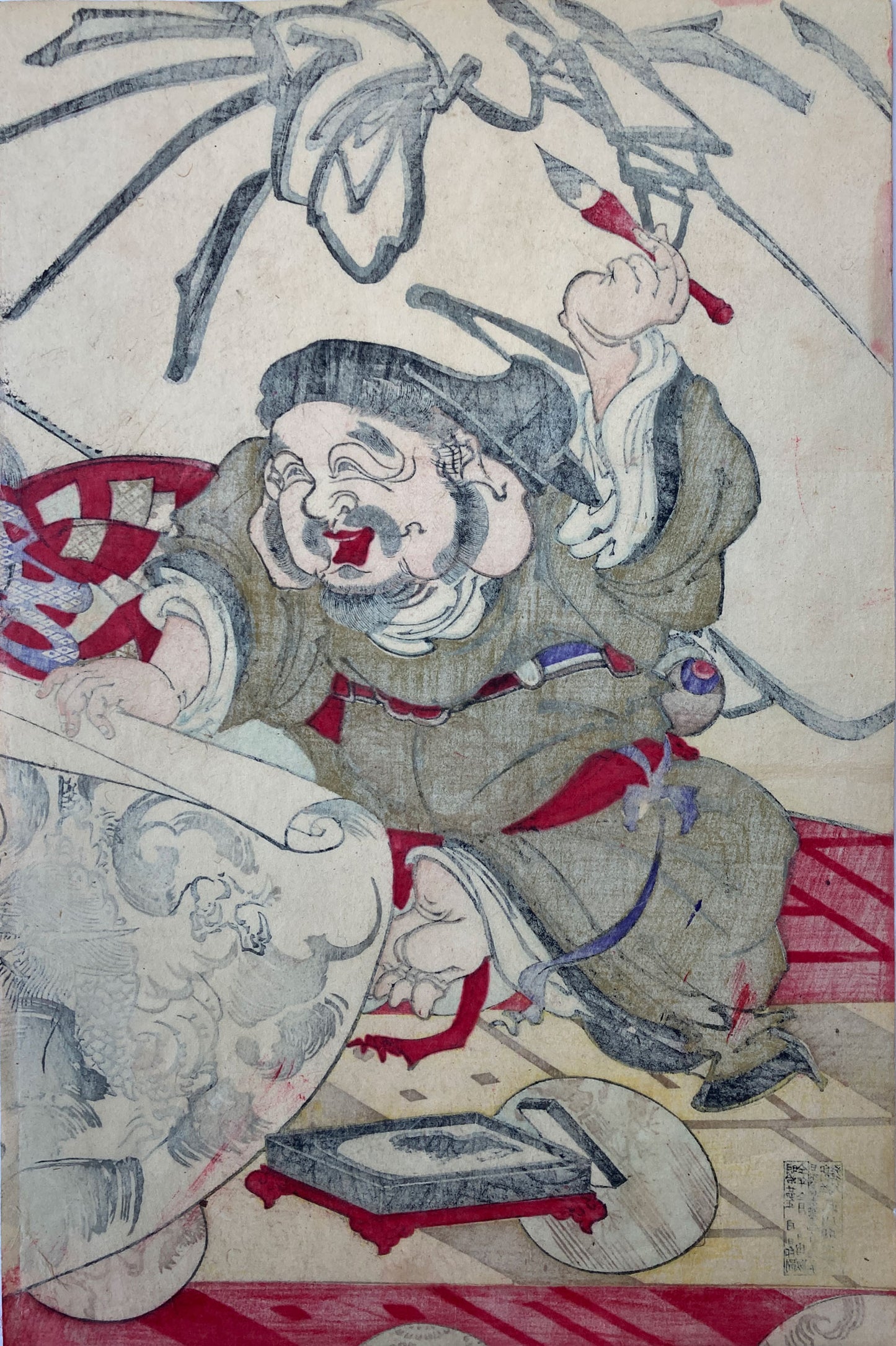
Colorful triptych print by Kyōsui. Title: Seven Lucky Gods Celebrate the Year of the Dragon. Kyōsui was fond of creating images of the 7 lucky gods - their joyous nature and quirky, magical personalities must have appealed to her.
The Shichifukujin, or Seven Lucky Gods, are a beloved group of deities in Japanese mythology and culture. Originating from diverse religious backgrounds including Shinto, Buddhism, and Hinduism, these seven gods are believed to bring good fortune and blessings to their worshippers.
Kyōsui learned painting with her father Kawanabe Kyōsai. Kyōsai encouraged his students to copy his work carefully to become proficient. As one of his students, Kyōsui became adept at this, producing works that to this day are indistinguishable from her father's, created in his name.
Condition: Good condition and color. Print is backed on thin Edo-era paper. Some stains and vertical creases as shown.
Size: (L) 35.6 x23.5 , (C) 35.2 x 24.4 , (R) 35.7 x 24.4cm
Date: 1891
Publisher: Takekawa Unokichi
Genre: Ukiyo-e
Medium: Woodblock Print
Couldn't load pickup availability
 Worldwide Shipping
- 30-Day Returns
 Authentic Print Guarantee



Who Was Kawanabe Kyosai?
Kawanabe Kyōsai (1831–1889) was one of the most dynamic and unconventional artists of late Edo and early Meiji Japan, celebrated for his technical brilliance and irreverent spirit. Working across a wide range of formats - including formal paintings, woodblock print designs, satirical sketches, and spontaneous works - Kyōsai defied easy categorization. From an early age, his talent was unmistakable; a well-known anecdote recounts how, at just nine years old, he retrieved a severed human head from the Kanda River to study its anatomy, reflecting both his curiosity and his commitment to observation.
Kyōsai’s artistic training was equally rigorous and diverse. He first studied under Utagawa Kuniyoshi, whose influence is evident in Kyōsai’s fascination with the grotesque and fantastical. He later entered the Kanō school, where his exceptional skill earned him the nickname “the painting demon.” Yet, like many independent-minded artists, Kyōsai resisted strict adherence to academic conventions. His work drew from multiple traditions, blending classical techniques with Western approaches to anatomy and perspective, while also embracing humor, satire, and the depiction of everyday life.
A fiercely independent voice, Kyōsai is often regarded as Japan’s first political caricaturist. His satirical images, which frequently targeted authority and social norms, led to his arrest on several occasions. Despite this, he remained a popular and prolific figure, particularly known for his performances at shogakai - public painting events where audiences commissioned spontaneous works. These lively gatherings showcased his speed, wit, and theatricality, and resulted in thousands of paintings, many mounted as scrolls for display in private homes.
Kyōsai’s artistic imagination found its fullest expression in his depictions of demons, skeletons, animals, and folklore, subjects he returned to throughout his life. His 1887 illustrated treatise, Kyōsai Gadan, offers insight into both his technique and worldview, combining instructional material with autobiographical and fantastical imagery. Though often criticized for his eccentric lifestyle - he was known for heavy drinking and a bohemian temperament - Kyōsai maintained a sharp awareness of his own mastery. When challenged over the high price of a painting, he famously replied that the cost reflected not the subject, but a lifetime of disciplined training. Today, he is widely seen as a successor to Katsushika Hokusai, bridging the worlds of Edo-period tradition and modern artistic expression.

Guaranteed Authentic
All our original woodblock prints are guaranteed authentic as described and shown. Unlike some print resellers, we don't make any Photoshop enhancements or add filters to our print images. Please check the print images front and back carefully before purchase, if you'd like additional pictures feel free to contact us. If, after purchase, you're not satisfied for any reason, return your print for a full refund within 30 days.
Collector Reviews
-

It's a great looking piece which I am very happy and excited to add to my small collection! I really appreciate it.
I enjoy your YouTube videos and I look forward to picking up more prints from you in the future.
Rick
-
Dear Mr. Richard, opening the package and seeing the incredible bright colours and ornamental abundance of Yoshitoshi's diptych, it was just as printed today! It will be a pleasure to get more of your fine selected prints.
L. F.
-
Josh and I just opened the package and want to thank you for this amazing Hiroshige print. The condition is better than we expected. Lovely to look at, will bring the family great joy. Happy New Year and thank you again.
J.
