


Kunisada - Shundo Genban and Yotarekuri
Kunisada - Shundo Genban and Yotarekuri
Utagawa Kunisada (1786-1865)
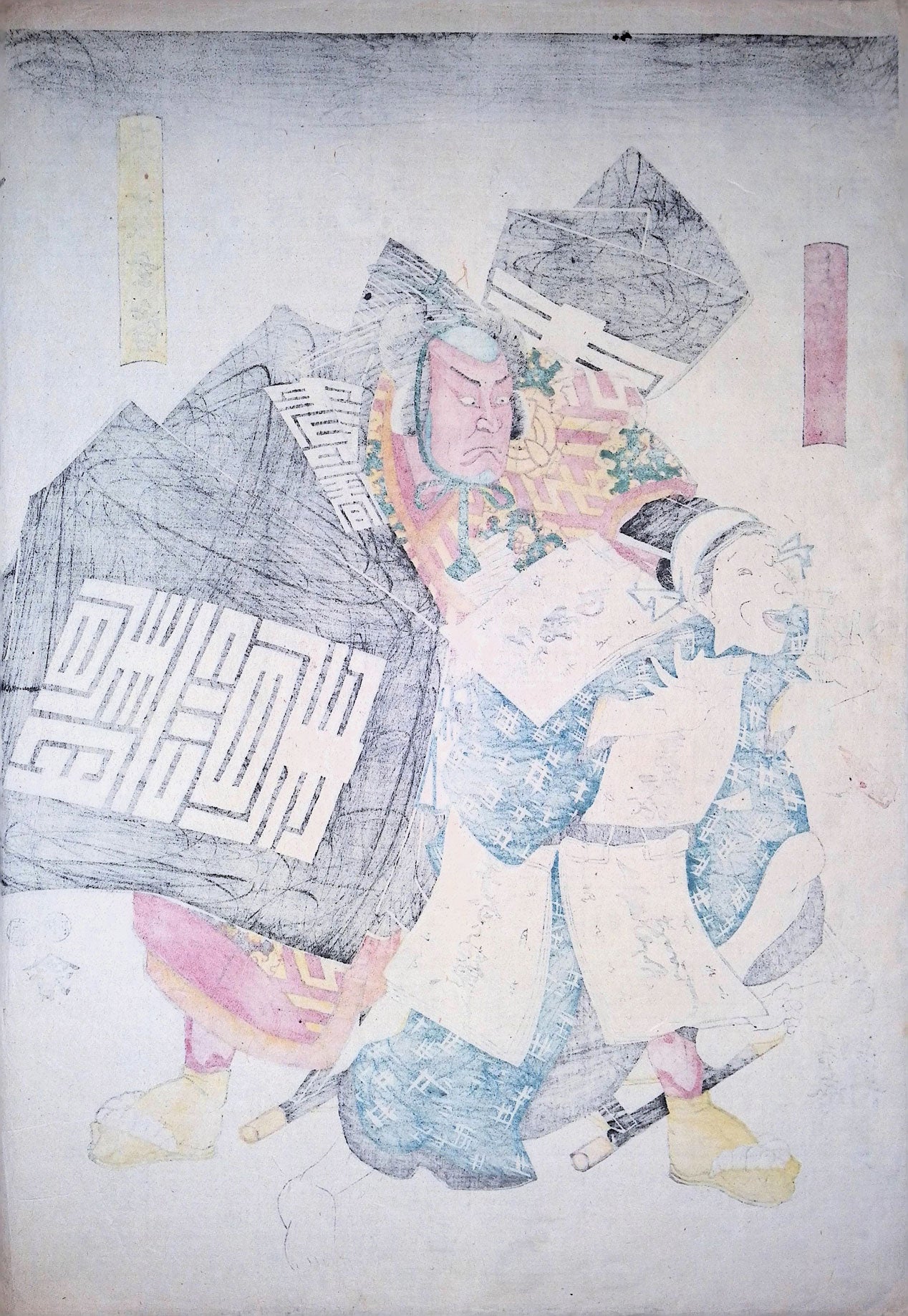
Title: Shundō Genban and Yotarekuri
Date: 1850
Genre: Ukiyo-e, Yakusha-e
Medium: Original Japanese Woodblock Print, Oban
Publisher: Hamaya
This original Japanese woodblock print by Utagawa Kunisada depicts the theatrical characters Shundō Genban and Yotarekuri in a lively and highly stylized composition. The towering figure of Genban looms behind the comically expressive Yotarekuri, whose costume is adorned with hanging papers and documents. Through exaggerated forms, bold costume patterns, and dynamic asymmetry, Kunisada transforms a theatrical moment into an engaging and humorous image that exemplifies his mastery of Kabuki portraiture during the late Edo period.
Condition: Very good condition, not backed
Couldn't load pickup availability
 Worldwide Shipping
- 30-Day Returns
 Authentic Print Guarantee



Who Was Utagawa Kunisada?
Utagawa Kunisada (1786–1865), also known later in life as Toyokuni III, was one of the most successful and prolific ukiyo-e artists of the Edo period. He was born in 1786 in Honjo, near Edo (modern Tokyo), into a comfortably well-off merchant family. His father, a ferry owner and amateur poet, encouraged Kunisada’s early interest in the arts, allowing him to study drawing and painting from a young age.
In 1800, at just fourteen years old, Kunisada became a pupil of Utagawa Toyokuni, the head of the influential Utagawa School. Under Toyokuni’s guidance, he quickly mastered figure drawing and composition, adopting the name Kunisada as part of the traditional artist lineage. His rise was rapid: by around 1813 he was already regarded as the leading ukiyo-e designer in Japan, enjoying immense commercial success and widespread public recognition.
During his lifetime, Kunisada was arguably more popular than contemporaries such as Hokusai, Hiroshige, and Kuniyoshi. His appeal lay in his ability to capture the fashions, personalities, and dramatic flair of Edo-period urban culture. He was especially celebrated for his actor prints (yakusha-e), bijin-ga (images of beautiful women), and illustrations of popular kabuki theater, all rendered with bold color, expressive linework, and an instinctive sense of storytelling.
Kunisada’s productivity was extraordinary. Over a career spanning more than sixty years, he designed over 20,000 works, including single-sheet prints, illustrated books, paintings, and collaborative series. Of course he had a stable of apprentices to assist him. This vast output, combined with his technical skill and deep connection to popular culture, made him a defining visual voice of nineteenth-century Japan.

Guaranteed Authentic
All our original woodblock prints are guaranteed authentic as described and shown. Unlike some print resellers, we don't make any Photoshop enhancements or add filters to our print images. Please check the print images front and back carefully before purchase, if you'd like additional pictures feel free to contact us. If, after purchase, you're not satisfied for any reason, return your print for a full refund within 30 days.
Collector Reviews
-

It's a great looking piece which I am very happy and excited to add to my small collection! I really appreciate it.
I enjoy your YouTube videos and I look forward to picking up more prints from you in the future.
Rick
-
Dear Mr. Richard, opening the package and seeing the incredible bright colours and ornamental abundance of Yoshitoshi's diptych, it was just as printed today! It will be a pleasure to get more of your fine selected prints.
L. F.
-
Josh and I just opened the package and want to thank you for this amazing Hiroshige print. The condition is better than we expected. Lovely to look at, will bring the family great joy. Happy New Year and thank you again.
J.
