


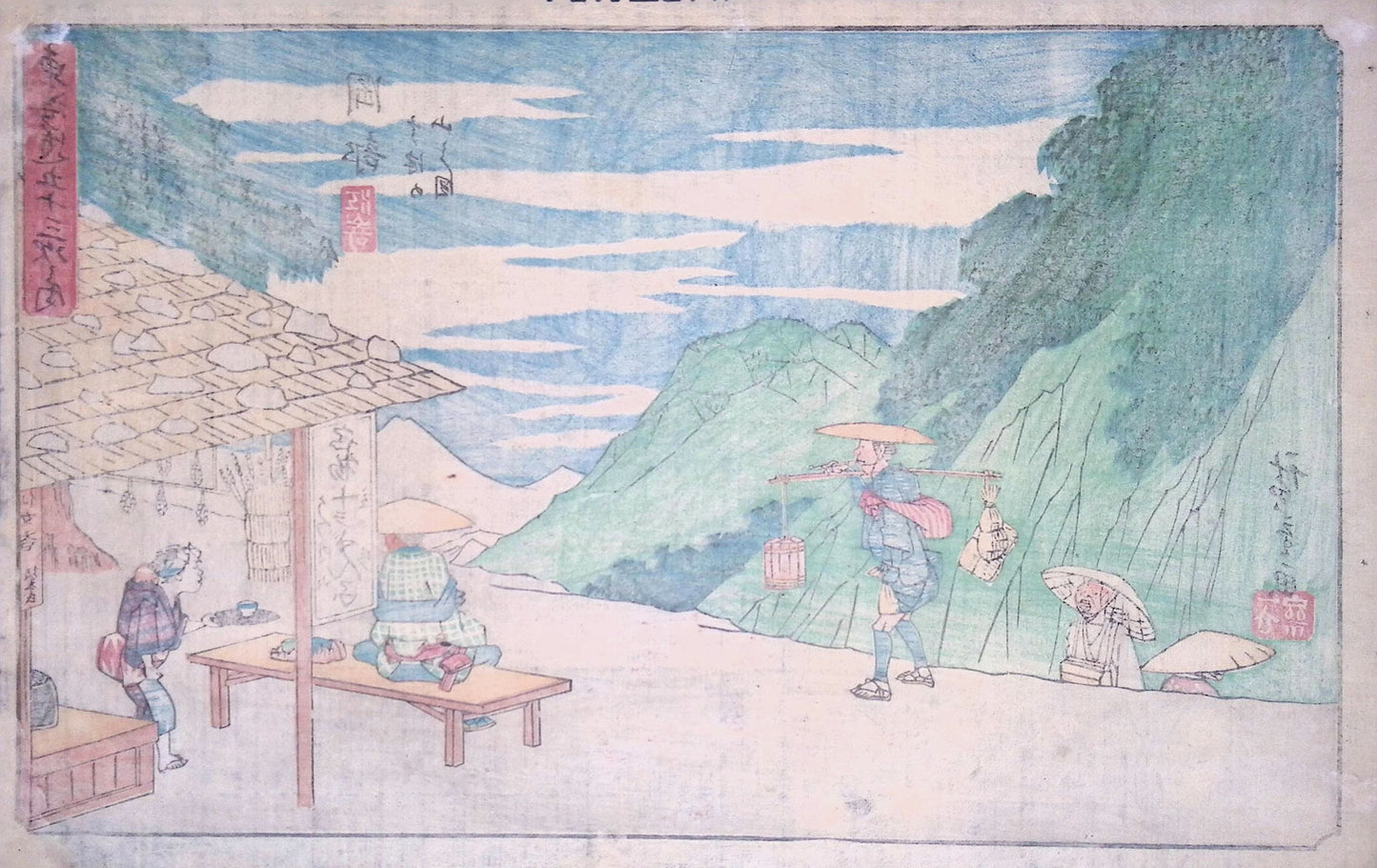
Hiroshige - Gyosho Tokaido
Hiroshige - Gyosho Tokaido
Utagawa Hiroshige (1797–1858)
Date: 1841
Series: The Fifty-three Stations
Publisher: Ezakiya Kichibei (Tenjudō)
Genre: Ukiyo-e, Meisho-e
Medium: Woodblock Print, Oban
Okabe-juku was one of the post towns along the historic Tōkaidō Highway, located in present-day Shizuoka Prefecture. Travelers crossing the rugged Utsunoya Pass, one of the route's most challenging sections, were rewarded with the famous Ten Dango ("Ten Dumplings").
According to local legend, the dumplings originated as protection against a man-eating demon. The demon had once been a novice monk who, after treating an abbot's illness, developed a craving for human flesh and terrorized travelers at Utsunoya Pass. The poet Ariwara no Narihira prayed to Jizō Bosatsu for help. Disguised as a traveling monk, Jizō cleverly flattered the demon into shrinking itself to fit in his hand, then broke it into ten small pieces and consumed them. The Ten Dango were created in remembrance of this legend and came to be eaten as a charm to ward off evil.
This print comes from Hiroshige's The Fifty-three Stations of the Tōkaidō (Gyōsho Edition), a series distinguished by its semi-cursive (gyōsho) calligraphy. Produced in a slightly smaller format than the famous Hōeidō edition, the Gyōsho series offers a more intimate interpretation of Japan's celebrated highway while retaining Hiroshige's masterful landscapes and storytelling.
Condition: Good overall condition and color. Minor stains as shown. Not backed, minor backing residue.
https://www.metmuseum.org/art/collection/search/37220
Couldn't load pickup availability
 Worldwide Shipping
- 30-Day Returns
 Authentic Print Guarantee



Who Was Utagawa Hiroshige?
Utagawa Hiroshige (1797–1858) was a leading creative figure of the late Edo-period ukiyo-e tradition and is widely regarded as the foremost landscape print designer of nineteenth-century Japan. Born in Edo to a lower-ranking samurai family, he inherited his father’s position as a fire warden while still in adolescence. Around the age of fourteen, he entered the Utagawa school as a pupil of Utagawa Toyohiro. In addition to his formal training, Hiroshige absorbed stylistic elements from the Kanō and Shijō schools, aspects of Chinese literati painting, and Western linear perspective, synthesizing these influences into a distinctive and atmospheric approach to landscape design.
Hiroshige achieved widespread recognition in 1832 with the publication of Tōkaidō gojūsan tsugi (The Fifty-three Stations of the Tōkaidō), a series that redefined the landscape genre within ukiyo-e. Rather than presenting purely topographical views, he emphasized seasonal change, meteorological effects, and the presence of travelers within the natural environment, thereby infusing his compositions with lyrical and narrative qualities. Over the course of his career, he produced more than 8,000 designs encompassing a broad range of subjects - including bijin-ga, yakusha-e, and historical themes - though landscape series remained central to his artistic identity.
Hiroshige’s mature work is characterized by innovative compositional structures, expressive use of color gradation (bokashi), and a refined sensitivity to mood and spatial recession. His prints exerted significant influence not only on subsequent generations of Japanese artists, including his successors Hiroshige II and III, but also on European Impressionist and Post-Impressionist painters in the late nineteenth century. Today, Hiroshige’s oeuvre stands as a defining achievement of ukiyo-e and a critical bridge between Edo-period visual culture and global modernism.

Guaranteed Authentic
All our original woodblock prints are guaranteed authentic as described and shown. Unlike some print resellers, we don't make any Photoshop enhancements or add filters to our print images. Please check the print images front and back carefully before purchase, if you'd like additional pictures feel free to contact us. If, after purchase, you're not satisfied for any reason, return your print for a full refund within 30 days.
Collector Reviews
-

It's a great looking piece which I am very happy and excited to add to my small collection! I really appreciate it.
I enjoy your YouTube videos and I look forward to picking up more prints from you in the future.
Rick
-
Dear Mr. Richard, opening the package and seeing the incredible bright colours and ornamental abundance of Yoshitoshi's diptych, it was just as printed today! It will be a pleasure to get more of your fine selected prints.
L. F.
-
Josh and I just opened the package and want to thank you for this amazing Hiroshige print. The condition is better than we expected. Lovely to look at, will bring the family great joy. Happy New Year and thank you again.
J.

Hiroshige Videos
-

The Three Hiroshiges
Watch on YouTubeDid you know there were 3 Hiroshiges? In this video we’ll track down the stories behind Hiroshige I, II and III.
-

Kawase Hasui VS Hiroshige
Watch on YouTubeKawase Hasui and Utagawa Hiroshige - The masters of Shin-hanga and Ukiyo-e landscapes compared.
-

Unbox Hiroshige Prints
Watch on YouTubeToday's unboxing of Prints by the artist Hiroshige has a twist. The auction house didn't post pictures of 2 of the 5 prints.


